

US spot Bitcoin ETFs have recorded about $5.39 billion in cumulative net outflows in November, according to SoSoValue data reported by The Block. That is already more than any complete month since the funds launched in January 2024, and the month still has trading days left. The previous record was $4.51 billion, set in June 2026.
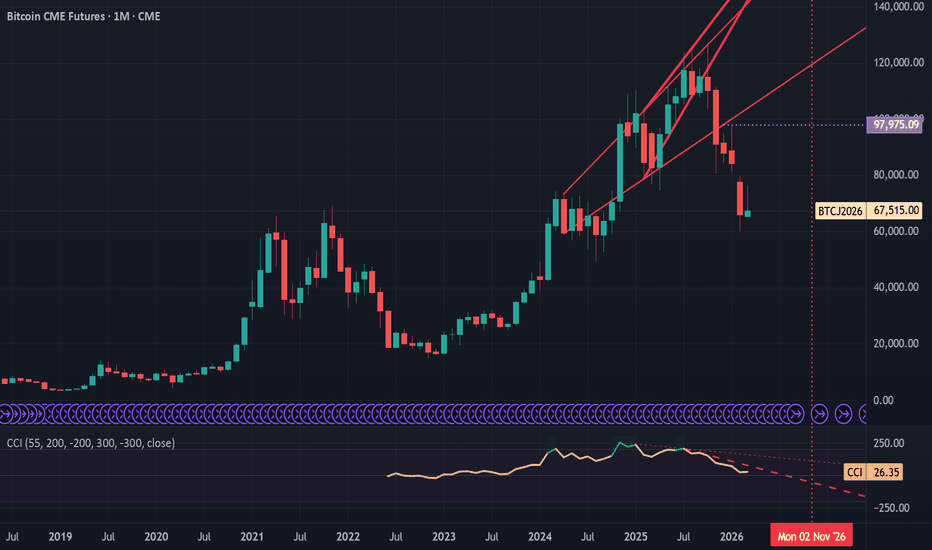
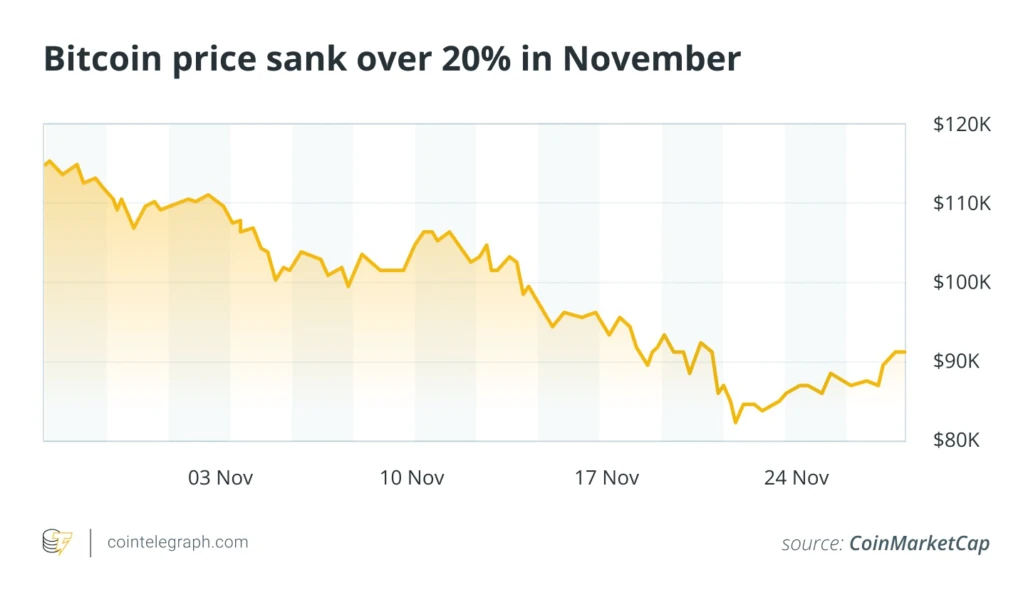
Bitcoin has fallen roughly 22% over the same month, and the funds’ combined net assets have shrunk to about $72 billion. This is how the record Bitcoin ETF outflow month happened, what is driving it, and what it does and does not tell you about institutional demand.
The record, in numbers
The headline figure is the monthly total, but the shape of the month matters as much as its size. Selling was concentrated in a single seven-session stretch, and in a single fund.
| Period | Net flows | Context |
|---|---|---|
| November 2026 (to 25 Nov) | −$5.39 billion | Record month; prior record was $4.51 billion |
| June 2026 | −$4.51 billion | Previous monthly record |
| 2025 (full year) | +$21.37 billion | Second calendar year of the funds |
| 2024 (full year) | +$35.24 billion | Launch year |
| 2026 year to date (to 25 Nov) | −$5.02 billion | Would be the first negative calendar year |
Two details are easy to miss. First, the year was still marginally positive before November: subtract the month’s $5.39 billion from the $5.02 billion year-to-date outflow and the funds were about $370 million net positive through October. A single month has flipped the whole year.
Second, the outflow figure is smaller than the fall in assets. Total net assets across the US spot Bitcoin ETFs sat at about $72 billion on 25 November, down from roughly $110 billion in mid-September. Part of that gap is money leaving, and part is simply Bitcoin trading lower. Flow data measures redemptions; it does not measure the mark-to-market loss on what stayed.
Data providers differ slightly on the totals because of timing and methodology, and US markets were closed on Thursday, 26 November for Thanksgiving, with a shortened session on Friday. The $5.39 billion figure is The Block’s tally using SoSoValue data, through the 25 November session.
Seven straight sessions, and one fund doing most of the damage
From 17 to 25 November the funds logged seven consecutive days of net outflows, the longest negative streak of the year. Those seven sessions removed roughly $3.05 billion — more than half the month’s total, according to Cryptopolitan’s analysis of the flow data.
Wednesday, 25 November was typical of the pattern: $453.1 million left the funds, with BlackRock’s iShares Bitcoin Trust (IBIT) accounting for $329.7 million of it, followed by products from Grayscale and Bitwise, The Block reported. No single fund recorded a net inflow that day.
That concentration is the part worth understanding. IBIT is the largest and most liquid of the group, so it takes the largest share of any market-wide move in either direction. Over the month, IBIT has accounted for roughly $4.5 billion of the outflows — more than 80% of the industry total — according to Bitcoin.com News. In the week to 20 November alone, the funds shed $1.79 billion, their largest weekly withdrawal since the week ended 26 June, and IBIT was $1.37 billion of that, per The Block.
The same pressure showed up outside Bitcoin. US spot Ether ETFs recorded $68.5 million of net outflows on 25 November, their ninth straight negative session, taking the month to $1.3 billion against $1.6 billion in October. This is not a Bitcoin-specific story; it is an allocation story.
The macro backdrop: a December rate hike is nearly priced in
Justin d’Anethan, head of research at Arctic Digital, told The Block that the recent volatility is mainly macro-driven, “as one can see all risk assets retracing aggressively”. He added: “Blame it on the Democratic win, or rate expectations, or geopolitical conflict, or an AI trade recalibration, but every investor out there is evaluating how much risk they’ve taken and should hold moving forward.”
The rate expectations are the clearest of those drivers. October’s core Personal Consumption Expenditures index — the Federal Reserve’s preferred inflation measure — rose 3.3% year on year, above the 3.2% expected and up from 3.1% in September. Headline PCE came in at 3.8%, up from 3.6%. Core prices rose 0.3% month on month for a third straight month.
“The continued strength in core PCE inflation … make[s] a December rate hike certain,” Bradley Saunders, economist at Capital Economics, told Yahoo Finance.
Markets agree. CME Group’s FedWatch tool put the probability of a quarter-point increase at the 8–9 December meeting at 97.6% as of 25 November, up from 68.9% a month earlier. That would lift the target range from 3.75%–4.00% to 4.00%–4.25%. The January meeting is priced at roughly a 59% chance of a second increase.
This matters for ETF flows because higher policy rates raise the return on cash and make a non-yielding asset harder to hold. A fund that was easy to justify in a cutting cycle needs a stronger argument in a hiking one. Fed governor Christopher Waller has gone further than most, saying the central bank needs to reverse last year’s three quarter-point cuts and that a half-point move “should be considered” in December if core inflation stayed at 0.3% or higher.
The December problem: tax-loss harvesting
Macro explains why the selling started. It may not explain why it could continue into December.
Analysis published by 10x Research on 25 November put the estimated average purchase price of Bitcoin held through US spot ETFs at about $82,224. With Bitcoin trading near $61,000 at the time, that implies an average unrealised loss of roughly 25% across the funds’ holdings.
For a US investor who has gains elsewhere in the portfolio this year, selling a Bitcoin ETF position at a loss before 31 December converts that paper loss into a realised one that can offset taxable gains. That is ordinary year-end portfolio management, not a verdict on Bitcoin. It also means some of the December flow data may reflect tax arithmetic rather than a change of view.
Rick Maeda, head of markets at Laevitas, made the same point in The Block’s coverage, noting that the macro backdrop and fears around AI progress have weighed on crypto assets, “not to mention tax-loss harvesting as we head into the year-end period.”
The tax effect cuts both ways, and nobody has published a reliable estimate of its size. Treat it as a plausible amplifier of December outflows, not a forecast.
What analysts are actually saying
The sell-side is split, and the split is informative.
The most notable shift came from Galaxy. Head of firmwide research Alex Thorn withdrew the firm’s October call that Bitcoin’s bear market had ended in June. Galaxy now treats a daily close below $58,525 — the 30 June closing low — as the start of a move toward a materially lower low. Bitcoin traded near $59,000 on 28 November, so the line is close.
21Shares said it expects rallies to fade until stablecoin supply and ETF inflows recover, and flagged the realised price near $53,250 as one of the levels to watch.
Nansen’s senior research analyst Nicolai Sondergaard argued the opposite case on interpretation: the selling looks like a cyclical reduction in risk rather than a structural exit. Cumulative net inflows across the funds remain around $52 billion, or about 83% of their October 2025 peak. His caveat is the important part — Nansen’s data shows large wallets that rarely move coins absorbed a net 10,000 BTC from exchanges over the past month, against roughly 70,000 BTC sold by the ETFs. The dip is not being bought at scale by the holders who usually do.
“Persistent ETF outflows weaken spot demand, increasing downside risks and limiting sustainable rallies,” said Dominick John, an analyst at Zeus Research.
LVRG Research’s chief analyst Dan Khus described the streak as sustained institutional de-risking that keeps pressure on prices and forces traders to prioritise capital preservation until flows stabilise. He also named the conditions that would change it: “Catalysts such as clearer Fed policy signals, cooling inflation data, or a decisive shift back to net inflows could quickly restore institutional demand and support a rebound.”
On the derivatives side, a BIT Research spokesperson told Bitcoin.com News that Friday’s roughly $7 billion Deribit expiry — 112,000 contracts — had been set up defensively, with the put-call ratio at about 0.89 against 0.55 in October and heavy put open interest between $63,000 and $75,000. With spot near $60,000, most of those puts finished in the money, and dealers hedging them had been selling into weakness. As the positions roll off, that mechanical pressure should ease: “We would not mistake that for a turn in the trend,” the spokesperson said. “The macro backdrop has not changed, and new hedging demand is already building into the December expiration.”
What this means if you hold Bitcoin
Nothing mechanical changes for a retail holder. There is no redemption mechanism, no forced selling, no rule that says a record outflow month must be followed by another. What the data does give you is a cleaner read on who has been selling.
The sellers are fund holders, not the network. ETF redemptions mean authorised participants handed shares back and the funds sold Bitcoin to meet them. That is real spot selling, which is why it moves price. It is also reversible in a way that a change in protocol fundamentals is not: flows can turn positive in a week.
Concentration cuts both ways. IBIT carrying more than 80% of the month’s outflows means the industry’s flow data is now largely a BlackRock data series. A single allocator trimming a model portfolio can look like an industry-wide verdict.
Watch the cumulative number, not the monthly one. The funds have taken in roughly $52 billion net since launch. November’s $5.39 billion is a dent in that, not a reversal of it — but a second month of similar size would start to change the picture, and 2026 would end as the first negative calendar year for the products.
If you hold Bitcoin on an Indian exchange or through an offshore fund, the US flow data is still the best single gauge of what large allocators are doing, because those funds are where the largest, most transparent institutional positions sit. It is not a signal to act on by itself, and it is not a price forecast.
What to watch next
- Month-end flow prints. The $5.39 billion figure runs through 25 November. Friday’s shortened session and the final days of the month will set the official total, and a figure above $6 billion would be a materially worse month than the current record.
- The 8–9 December Fed meeting. A quarter-point hike is close to fully priced. The surprise risk is a half-point move, which Waller has publicly floated.
- A daily close below $58,525. This is Galaxy’s line for the start of a move toward a lower low.
- The $53,250 realised price. 21Shares’ reference level for where rallies have historically stalled.
- 31 December. The US tax-loss deadline. Watch whether outflows accelerate into it and then reverse in January.
- Whether spot demand absorbs the supply. Nansen’s 10,000 BTC against 70,000 BTC is the number to watch change.
Frequently asked questions
How much money left Bitcoin ETFs in November 2026?
About $5.39 billion in cumulative net outflows through the 25 November session, according to SoSoValue data reported by The Block. That is the largest monthly net outflow since the US spot Bitcoin ETFs launched in January 2024, surpassing the $4.51 billion recorded in June 2026.
Which Bitcoin ETF had the biggest outflows?
BlackRock’s iShares Bitcoin Trust (IBIT). It recorded $329.7 million of net outflows on 25 November alone, and has accounted for roughly $4.5 billion of the month’s total, or more than 80% of the industry figure, according to Bitcoin.com News.
Does a record outflow month mean institutions are abandoning Bitcoin?
Not according to the flow data itself. Cumulative net inflows across the funds remain around $52 billion, about 83% of their October 2025 peak, per Nansen. Analysts describe the selling as de-risking and year-end tax management rather than a structural exit, though Nansen also notes that large long-term holders have absorbed far less of the supply than the ETFs have sold.
Why are Bitcoin ETF outflows happening now?
Three forces are cited by analysts: a macro backdrop where the Federal Reserve is expected to raise rates on 8–9 December, a broader retreat from risk assets, and year-end tax-loss selling in the US, where the average ETF-held Bitcoin was bought near $82,224 against a market price around $60,000.
Will Bitcoin ETF flows recover in December?
Nobody knows, and anyone who says otherwise is guessing. The identifiable headwinds — the Fed meeting and the 31 December tax deadline — both land in December. The identifiable tailwind is that mechanical selling from Friday’s $7 billion options expiry has now rolled off, which BIT Research expects to relieve pressure temporarily without changing the trend.
The bottom line
A record $5.39 billion left US spot Bitcoin ETFs in November, more than 80% of it from a single fund, against a 22% fall in Bitcoin’s price and a Federal Reserve that markets expect to tighten again in nine days. The flows are real selling, but they are also concentrated, partly tax-driven, and small against the roughly $52 billion the funds have taken in since launch. The number that matters next is not November’s — it is whether December adds to it.
For the earlier milestones in this run of outflows, see our coverage of Bitcoin ETF outflows reaching $3.5 billion and Friday’s $7 billion options expiry.
This article is for information only and is not financial advice. Prices and flow data are as of 25–28 November 2026 and change daily.
Sources
- The Block — Spot bitcoin ETFs on track for worst month on record (26 Nov 2026)
- The Block — Spot bitcoin ETFs shed $1.79 billion in past week (23 Nov 2026)
- CoinDesk — Bitcoin ETFs are bleeding cash (26 Nov 2026)
- Bitcoin.com News — Bitcoin’s Thanksgiving rally unravels (27 Nov 2026)
- Crypto News Australia — Record outflows as year-end tax deadline looms (27 Nov 2026)
- Yahoo Finance — PCE inflation heats up, solidifying a December rate hike (25 Nov 2026)
- EC Markets — Fed rate hike odds at 98% (CME FedWatch) (25 Nov 2026)
- CNBC — Fed rate hike December 2026: what consumers should know (25 Nov 2026)
- Reuters poll via Investing.com — Fed to raise rates once more in December (10 Nov 2026)
- Yahoo Finance — Bitcoin hovers near $59,000, worst month since June 2022 (25 Nov 2026)
- Fortune — Current price of Bitcoin for Nov. 25, 2026

Leave a Reply